

In the days when all people spoke a single tongue — homophonoi — they came together to build a tower that would reach the heavens. But the gods, displeased, blew a mighty wind that toppled the tower and scattered them with a confusion of languages.
~Antiquities of the Jews~
As an IT engineer, I’d like to introduce one of the languages I use every day — programming languages.
For those who have never used one,
Programming languages look like a bunch of strange symbols — they seem really hard…
That might be the impression you have. At first glance, it does seem that way, but it’s not as difficult as it looks (Of course, it gets tricky if you dive deep — but that’s true of anything)
Compared to the early days, programming has become much easier to read and learn. And with new tools appearing every year, it’s more approachable than ever. Even if you’re not an engineer, giving it a light try might help you appreciate its value — and maybe even lead to a few new discoveries!
Languages
First, a bit about the kinds of programming languages. Just like the languages we use every day — Japanese, Chinese, English — there are many kinds. These are called natural languages, and programming languages share that same diversity. Each has its own logo; if you line them up in a chart, it looks something like this (and of course, there are many more)
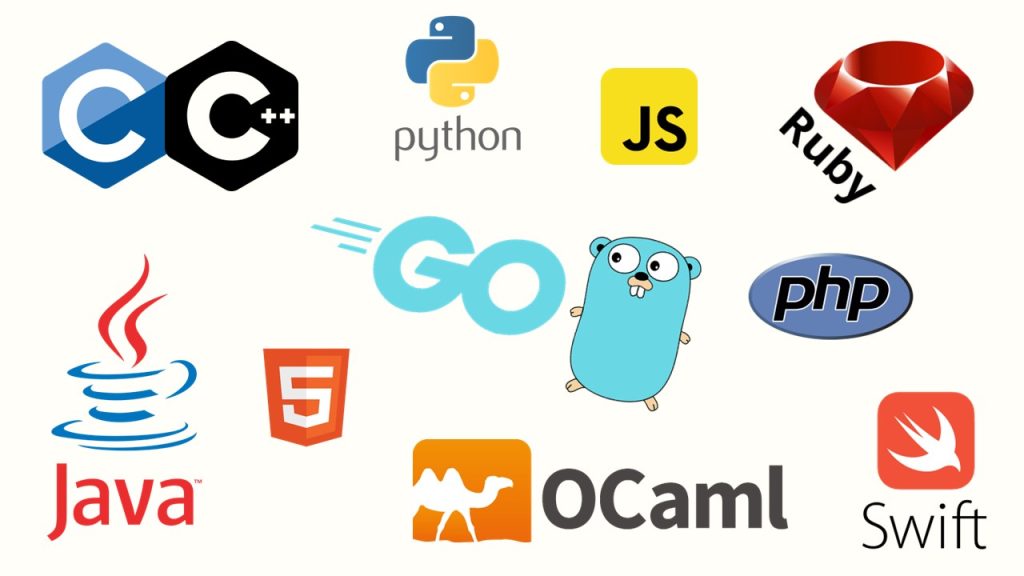
Even non-engineers may have seen or heard some of these before. Basically, they’re languages used to create programs that realize certain functions, so many share common foundations. Still, just like natural languages, each one has its own distinct characteristics — some are especially popular, others excel in particular fields.
Programming languages first appeared around the 1940s — meaning their history is less than a hundred years old. Yet new ones are constantly being born (And yes, you can even create your own programming language!)
Unlike natural languages, programming doesn’t involve listening or speaking — it’s all about reading and writing. It mostly uses English-based characters (though slightly different from everyday English), but the vocabulary and grammar are quite simple, even for non-native speakers. And for us introverts, there’s a big advantage — no need to talk at all 😅
Why Learn Programming Languages Today?
Here are some of the reasons I personally believe programming is worth learning — especially in today’s world.
Have you ever been using your computer or smartphone, only to have a confusing error message pop up out of nowhere? Or found yourself frustrated because it just wouldn’t do what you wanted?
Maybe you’ve even thought, “This is so hard to use” or “I have no idea what’s going on” (To be fair, things are a lot more user-friendly these days than they used to be)
Before I became an IT engineer, I was completely clueless about all that. I had a computer, sure, but I only used it for school assignments — just the bare minimum. Most of the time, it just sat there gathering dust.
But once I became an engineer and started learning programming languages, I began to understand how computers and smartphones actually work. I could start to guess what error messages meant and what was happening behind the scenes. That’s because computers and smartphones — and nowadays, almost everything from home appliances to cars — are all controlled by programming languages. So when I encounter unexpected issues, I don’t panic anymore. I can stay calm and deal with them logically.
You’ve probably felt it yourself — even without me saying so — the wave of digital transformation over the past few decades, and especially in recent years, has been nothing short of explosive.
Even I, as someone who works in tech, am sometimes overwhelmed by the pace of change — so for people in other industries, it must feel even more intense. And now, with the rise of AI, the speed of change has accelerated even further.
We might wish we could say, “This has nothing to do with me,” but the truth is, this digital wave is sweeping across every industry and profession. Many people probably feel that without at least some digital knowledge, it’s becoming difficult to keep up at work.
By learning a programming language, you naturally gain confidence with digital technology — from the internet and social media to cloud services and everyday devices like music players, game consoles, and smart home appliances.
As your understanding grows, your perspective changes — and even fields you once avoided can start to feel more interesting. You’ll begin to notice IT-related news more often, not because you have to, but because you want to. Before long, you’ll realize you’re not just being carried by the wave — you’re riding it.
As you browse the web or use apps on your computer or phone, have you ever thought,
“This website feels a little off…” or
“I wish there were an app that could do this…” ?
If you learn how to code, you can actually bring those ideas to life yourself.
Most websites, apps, and services are designed for the general public, so it’s rare to find one that perfectly fits your needs.
That’s understandable from a business perspective — but if you can code, it changes everything.
You can create a website that matches your taste, or build tools for your work or daily life — even apps for learning languages or preparing for exams. In short, you can make something by you, for you.
And if you feel like it’s too good to keep to yourself, you can customize and polish it, then release it to the world through an app store. Just thinking about that feels exciting, doesn’t it?
In a professional setting, programming usually follows a process:
You listen to the client’s needs, discuss ideas, design the system, and then start coding.
The features are often complex and large-scale, so it’s rarely something you can do alone — teamwork is essential. That teamwork can be rewarding, but let’s be honest — if you’re introverted, you still need your quiet time 😅
Now imagine this:
You get to build something you want, at your own pace, without anyone telling you what to do.
You work on it steadily, line by line, and one day it takes shape. It makes your life easier or more enjoyable — and maybe others will find it helpful too. Isn’t that kind of amazing?
The best part is, programming languages are universal — shared by developers all over the world. It doesn’t matter where you’re from; your code speaks for you. You can share your work globally, get feedback, offer advice, and connect with others through this shared language. Doesn’t that sound a bit like a dream?
That’s it for my take on the value of programming languages. Of course, there’s much more that couldn’t fit here, but if this article helped you feel even a little of their charm, I’m happy!
These days, there are also low-code and no-code tools that let you build apps with minimal or no programming at all. But that’s a story for another time~