

“The shed was filled with an orange glow, and when I first stepped inside it was hard to make out what was around me. […] Caught in that piercing light, I began to shape my thoughts into words within my heart.” ~Klara and the Sun~
“One has to enjoy life. Evening is the best time of day. You stretch your legs out, and simply take it easy.” ~The Remains of the Day~
This time, I’d like to talk about Kazuo Ishiguro (石黒一雄), the Japanese-born British novelist.
He became British long ago, yet as a Japanese person myself, I can’t help but feel a deep sense of kinship with him — and with his works.
The Man Himself
Ishiguro was born in Nagasaki, located far to the southwest of Tokyo. At the age of five, his family moved to the U.K. when his father, a marine scientist, took a job there. He never returned to live in Japan, and has remained based in Britain ever since.
As a writer, he studied literature and creative writing at university, making his debut in 1982 at the age of 27. Seven years later, his novel The Remains of the Day won the Booker Prize, Britain’s most prestigious literary award. In 2017, he received the Nobel Prize in Literature “for uncovering the abyss beneath our illusory sense of connection with the world in novels of great emotional force.”
At home he grew up speaking Japanese, while at school he spoke English. For some time, the family even imagined they might return to Japan. Ishiguro himself once believed that one day he surely would. But in the end, he never did return. That experience — of having to watch the “homeland he was meant to return to” only from afar — is, I believe, one of the key lenses through which his work can be understood. I’ll come back to this point later.
By the way, I recently visited Nagasaki myself (article here)
The place feels both nostalgic — like stepping into old Japan — and yet touched by foreign winds. It’s a landscape that feels like a natural birthplace for Ishiguro — at least to me, somehow.

As an aside, Ishiguro is also a Bob Dylan fan (and so am I…)
On Changing Nationality
Let me ask you something unusual:
Have you ever changed your nationality?
From the moment I was born, it was simply taken for granted that I would be Japanese, and so I have been all my life. The same goes for most people around me, whatever country you may come from — changing nationality is rare. Ishiguro, however, did acquire British citizenship after moving to the U.K.
If the earlier episode about the “homeland he was meant to return to” is true, it may not have been a choice he made freely or gladly. Perhaps there were circumstances that left him little alternative. Even so, this moment must have become a turning point—one that shaped his distinctive literary voice. Though I have never changed my own nationality, I can still imagine how profoundly significant such a decision must be.
A bit of background: the U.K. allows dual nationality, but Japan does not. So when Ishiguro acquired British citizenship (reportedly at age 29), he had to renounce his Japanese one. I sometimes hear of the reverse — foreign athletes naturalizing as Japanese citizens to represent Japan in sports. In other words, naturalizing as Japanese means giving up one’s original nationality.
So for Japanese people, “changing one’s nationality” essentially means giving up the citizenship of one’s country of birth and taking on a new one. If it were between neighboring Asian countries, it might not feel quite as momentous. But between Japan and the U.K., with such different peoples, histories, cultures, and ways of life, it must have been an even greater turning point for him.
I live my life here in Japan as a Japanese, and of course there are times when I feel discontent or find myself longing for life abroad. Yet even so, I imagine I’ll go on living here, grow old here, and in the end, rest my bones in this soil. I simply can’t picture myself spending my final days abroad. How about you?

To change one’s nationality is to repaint a part of who you are, to alter a piece of your identity. When I read Ishiguro’s works, words like ~ identity ~ memory ~ loss ~ often drift through my mind. He seems deeply aware of having two backgrounds, and he refines that awareness, turns it into his own unique color, and then projects it onto the page.
Works
From here, I’d like to introduce some of Kazuo Ishiguro’s novels, focusing on the ones I’ve read myself.
1.The Remains of the Day
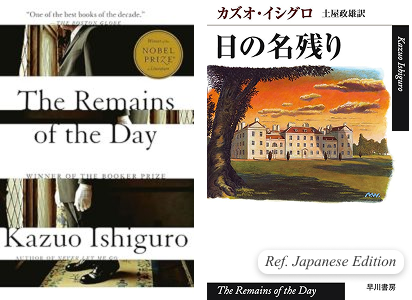
An aging English butler sets out on a solitary journey, reflecting on his life along the way. He carries deep pride in his role and performs it with quiet dedication — almost like a traditional Japanese craftsman.
Yet in revisiting his past, questions emerge:
Was that truly my life?
Was I right in how I treated those closest to me?
With restrained prose, Ishiguro lets such emotions seep through the spaces between lines. Set against the beauty of the English countryside and the glow of twilight, the novel carries a quiet melancholy that lingers long after reading.
The film adaptation starring Anthony Hopkins was also wonderful.
2.Never Let Me Go
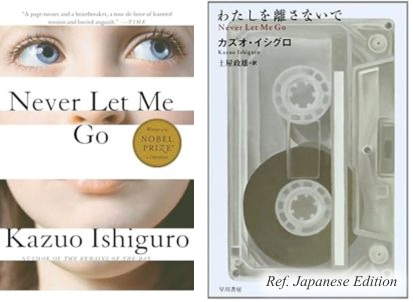
The story begins at a boarding school in rural England, at first resembling a nostalgic memoir. The protagonist, now working as a “carer,” looks back on memories with her classmates.
The children receive a normal education, growing up with friendships and first loves — seemingly like any others. Yet there’s a faint sense of unease. As the narrative unfolds, their extraordinary fate is gradually revealed.
It’s a work steeped in fragility and loss, stirring profound questions:
Who am I?
What am I living for?
3.Klara and the Sun
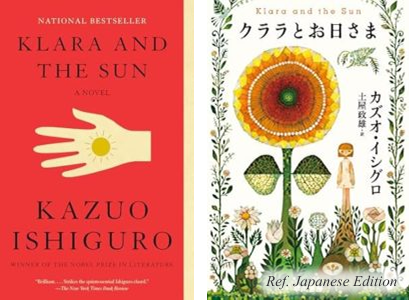
Klara is a robot equipped with artificial intelligence, designed as an “AF”— an Artificial Friend — for children. The story is told entirely through her eyes, offering a rare and moving perspective.
Through Klara’s eyes, the novel reflects the intricacies of human emotions, gestures, and relationships. In doing so, it asks us — living in the very age of AI — to look again at the questions:
What does it mean to be human?
How are we truly different from AI?
Klara runs on sunlight and trusts it almost like a god. Her childlike devotion makes her oddly endearing. Ishiguro’s depictions of sunlight — especially at sunset — are so delicate and poetic that they paint vivid images in the reader’s mind.
4.A Pale View of Hills
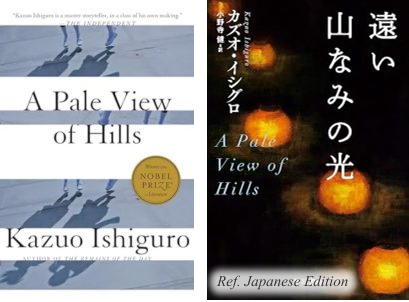
Ishiguro’s debut novel, in which a Japanese woman recalls her postwar life in Nagasaki from her home in England.
It was screened at the Cannes Film Festival
In Japan, it opened in theaters this September.
➢➢➢
That’s all for now.
I don’t often think consciously about my identity, but when I do, I realize I’m shaped by many selves: my Japanese self, my student self, the self I’m proud of, the self I’m ashamed of. All of them come together to form who I am today. And it makes me want to treasure that sense of self all the more from here on.