
Today, I’d like to share a story that left a deep impression on me from a book of fables I recently read.
The House Full of Villains
Once upon a time, in a small village, there were two houses standing side by side.
In one house lived a family of seven. Though large in number, they lived in peace and harmony, never quarreling.
In the other house lived a family of just three, yet they argued constantly, and their days were filled with unhappiness.One day, the father of the three-person household went to visit the larger family and asked, “I’ve heard that in your home, not a single quarrel ever breaks out, even though you live with six others. Meanwhile, in my home of just three people, we can’t seem to go a day without fighting. Why is that? What’s your secret?”
The father of the seven-person household smiled and said,
“That’s probably because my family is full of villains, while yours is full of good people.” The visitor blinked in confusion. “That makes no sense. Wouldn’t a house full of villains be full of conflict? How can there be no fighting if everyone is a villain?”The man replied gently,
“It’s actually quite simple. In our home, whenever something goes wrong — say someone knocks over the brazier or breaks a tea bowl — we all rush to say, ‘It was my fault. I was careless.’ We compete to take the blame. Because of that, arguments never arise. But in your house, it must be the opposite. When something goes wrong, each of you tries to be the good one. ‘It wasn’t me.’ ‘It was your fault.’ You shift the blame around and never let go of being right.”So if the brazier falls over, someone must say, ‘You’re the one who put it there!’ Or if a bowl breaks, ‘It’s the shelf’s poor design!’ No one wants to take responsibility. That’s why peace never lasts. In our home, we race to be the villain. In yours, you all race to be right. And that, I believe, is the difference.
From that day forward, the man of the three-person household tried to be more humble, and little by little, his family found harmony.
Self-Blame vs. Blame-Others Mindset
When I read this fable, I couldn’t help but feel that the three-person family reminded me of modern-day Japan.
Maybe it’s just me… But honestly, this kind of dynamic isn’t just something I’ve seen in the news — I’ve sensed it around me for years at work.
At the heart of this story is the contrast between two ways of thinking:
the self-blame mindset and the blame-others mindset.
When something goes wrong — a mistake, a conflict, a failure — do we look inward, or do we point fingers outward?
And if we’re bystanders, how should we view the situation?
If I had to draw it out, it might look something like this:
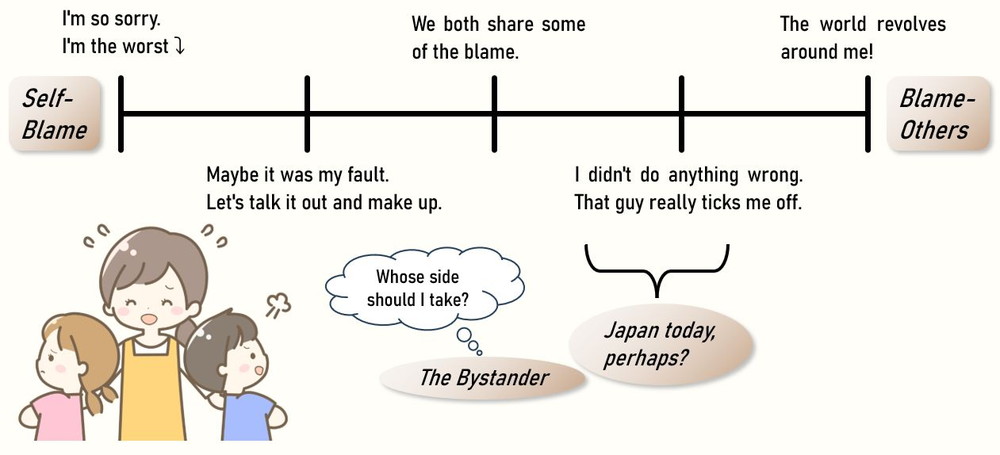
To be clear, I’m not saying that blaming others is always bad, or that self-blame is always noble. Both mindsets have their strengths and pitfalls. What really matters, I believe, is balance.
If the World Were a Village…
Since this blog is also written from an introvert’s point of view, I sometimes find myself seeing Japan through that lens.
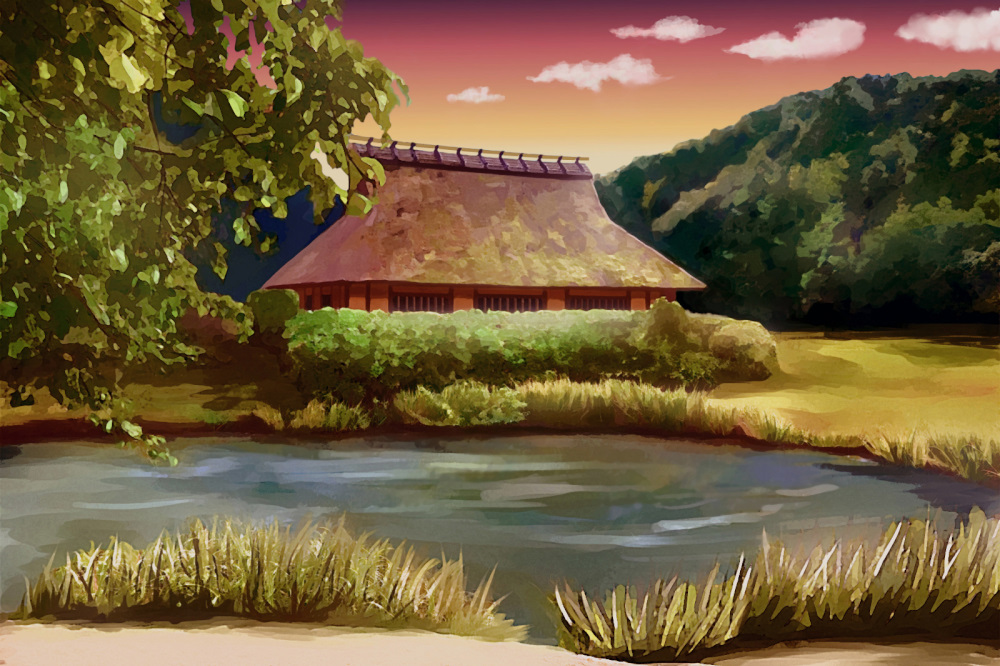
If the world were one village, maybe Japan would be that house at the far edge of town —
quiet, closed-off, hard to approach, with a heavy stillness hanging in the air.
And inside that house, perhaps a scene like the one in the fable is quietly unfolding —
a family locked in blame, unable to find peace.
Looking at Japan as a whole feels overwhelming. So I try narrowing it down — to the level of workplaces, for example — and all kinds of thoughts come up. But if I keep going, I might fall into the very trap of blaming that I’m trying to avoid. So I’ll stop there for now.
Maybe I’m being a bit too harsh.
What about you — do you ever find yourself looking critically at your own country?
The Virtues of Japan: Humility, Consideration, and Kindness
It’s human nature, I think —
To want credit when things go well, and to shift the blame when they don’t.
Not just in Japan. Anywhere.
I was no different. Back in my early 30s, I had a strong blame-others mindset. You could say I saw myself as a victim of circumstances. But over time, I began to notice a pattern: with that mindset, I kept finding myself in the same kinds of situations. And the world around me didn’t change at all.
Eventually, I realized the only thing I could really change was myself. And to do that, I needed to reflect. To take responsibility. To start small.
In shifting away from blame, one thing I want to hold on to is humility — the quiet strength to step back, to listen, and to lift others up. This kind of humility, I believe, is one of Japan’s most treasured virtues. Something we’ve long taken pride in. But lately… I feel like we’ve been losing it. Not just others — myself included. There’s a tightness in the air. Suspicion. A kind of spiritual poverty that’s hard to name. Is it just me who feels that…
But whatever the cause — lamenting alone won’t change anything. So once again, this article gave me a reason to pause and reflect.
To look at myself and my surroundings with a humble eye.
To ask: Is there something I can change? Even a little?
And if the answer is yes, then quietly, steadily, I’ll begin.
That’s all I can do. And maybe, that’s enough.