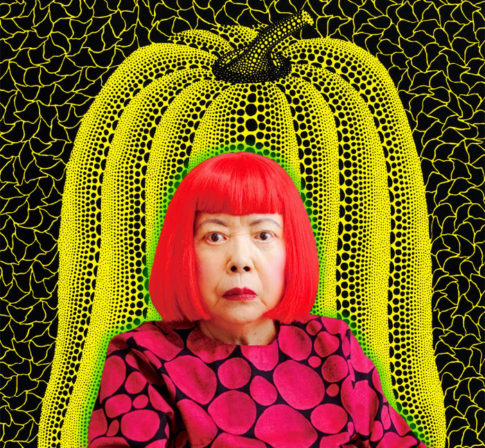

A Japanese woman instantly recognizable for her polka dots and striking appearance —
the artist Yayoi Kusama.
Amazingly, she is said to be approaching the age of 100. And yet, she continues creating with a vibrant energy that makes you forget her age entirely. Kusama has long declared that she intends to remain an artist for life.
In this article, I’d like to share a glimpse of who she is — through the unique perspective of this blog.
Her Life So Far
First, let’s take a brief look at her life and career.
○ Awakening to Art
Yayoi Kusama was born in 1929 in Nagano, a mountainous region west of Tokyo, into a wealthy family that ran a seed business. She began drawing at around the age of ten, often sketching the flower fields near her home.
While still in high school, one of her works was selected for a local art exhibition. After graduating, she enrolled at the Kyoto Municipal School of Arts and Crafts, where she studied traditional Japanese painting.
○ Crossing the Ocean to America
Although she continued working as an artist in Japan, few people in the local art world truly understood her work. Surrounded by a growing sense of frustration and confinement, she made a bold decision — to go to America. At the age of 27, despite strong opposition from her family, she crossed the ocean alone.
○ Years of Hardship
What awaited her first was the barrier of language. It was difficult to promote herself or negotiate opportunities in English. Then there were the obstacles of gender and race. In a male-dominated, largely white and Western art world, being an Asian woman became another heavy barrier.
She struggled to make ends meet, sometimes unable to afford basic living expenses. Even while suffering from chronic mental distress, she continued creating her art.
○ The Queen of the Avant-Garde
Her first solo exhibition was held in Seattle. Soon after, another exhibition in Manhattan attracted significant attention from avant-garde artists of the time, allowing her to establish a foothold in New York.
Her bold and often provocative performances frequently became the talk of the town, and she eventually came to be known as the “Queen of the Avant-Garde.”
Yet commercial success did not follow. Her income remained unstable, and life continued to be a struggle.
○ Returning to Japan
After the death of her beloved partner, Kusama returned to Japan at the age of 44. While continuing her artistic work, she went in and out of psychiatric hospitals. During this time, she also published novels and collections of poetry.
Gradually, after the age of sixty, her work began to receive recognition in Japan as well. In 1993, she was selected to represent Japan at the Venice Biennale.
The Venice Biennale is one of the world’s most prestigious international art festivals. With a history of more than 130 years, it is held every two years, alternating between art and architecture.
○ Becoming Known Across Japan
Later, she also ventured into commercial collaborations, including designing mobile devices and collaborating a collection with Louis Vuitton. At the age of 87, she became the fourth female painter to receive Japan’s Order of Culture.
And even now, at the age of 96, she continues to create with remarkable energy.

Mother, drawn at age 10 (Source:Artpedia)
Building an Inner World
It is said that from early childhood, Kusama experienced symptoms of schizophrenia. She was troubled by vivid hallucinations — her field of vision filling with endless polka dots or net-like patterns — and by auditory hallucinations, hearing dogs or flowers speaking to her in human voices.
To escape the fear that returned again and again, she began drawing pictures using polka dots and net patterns as motifs. Over time, these experiences would become the very source of her creative work.
Have you ever experienced hallucinations — seeing or hearing things that aren’t there?
I never have. But when I try to imagine it, I feel that such experiences must have been deeply shocking for a young child — something unforgettable for the rest of her life.
Imagine discovering that you alone see and hear these things.
The fear of that moment.
The quiet despair of knowing that even if you tried to explain it
to your parents or to your friends, no one would truly understand.
Something that cannot be shared.
Something you must carry within yourself.
I now understand and accept the fact that I am an introvert. But when I was a child, I didn’t even know the word introvert existed. In a world where extroverts are more common, I carried a quiet sense that something about me was different from those around me. Yet I could never quite put that feeling into words. And so I grew up with an unspoken heaviness in my chest — a vague knot of confusion I didn’t know how to untangle.
That may be why I feel I can somehow imagine what she must have gone through — though of course this is only my own speculation. People who experience hallucinations are surely far fewer than introverts. She must have felt an even greater distance between herself and the people around her. A dull, lingering pain, with no clear way to escape it. I believe that for her, these experiences became a kind of trauma — something that could never simply be erased.
It is also said that she struggled with her relationship with her parents. Along with her struggles with schizophrenia, these experiences may have led her to begin painting as a way to soothe the wounds in her heart.
In time, expressing herself through her work became a reason to live — something that supported her through a life filled with hardship, for nearly a hundred years.
Giving Form to Her Inner World
Now, I’d like to show you several works in which her inner world is vividly expressed.
Two important motifs appear again and again in her art: polka dots and net patterns.
― Repetition and infinity, obsessively repeated as if driven by a compulsion
― Patterns that spread across the surface, fill the space, and eventually envelop the artist herself
— self-obliteration
● Infinity Net Series
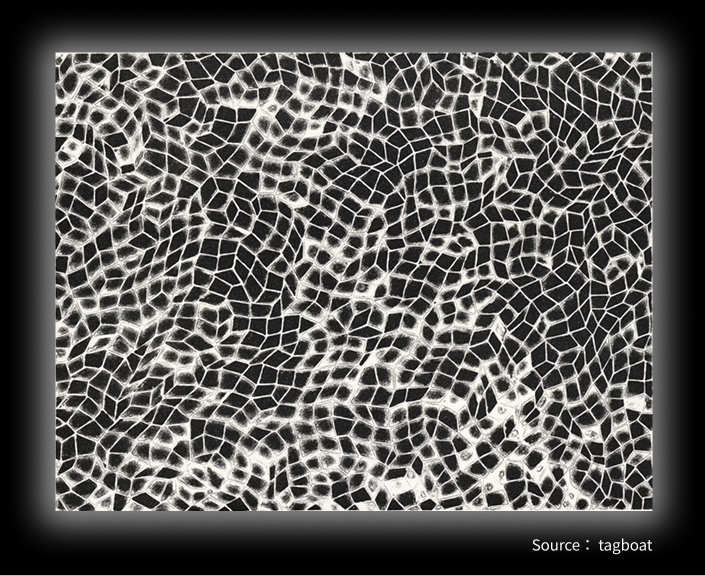
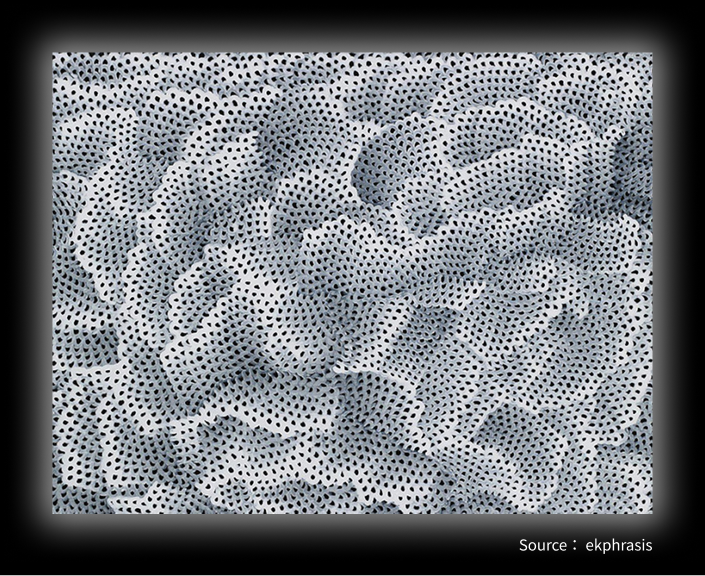
At the age of 30, in New York, Kusama created these works while living in extreme poverty.
She would paint endlessly across large canvases, repeating small forms over and over. At times, her hands became swollen from the strain. Even when critics dismissed the work as “too monotonous,” she refused to change her style.
She continues to develop this theme to this day, turning it into an ongoing series.
● Infinity Mirror Rooms
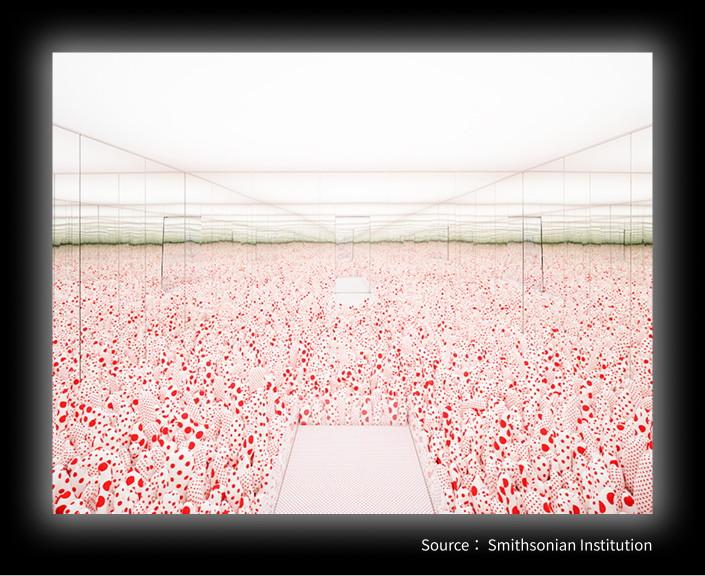
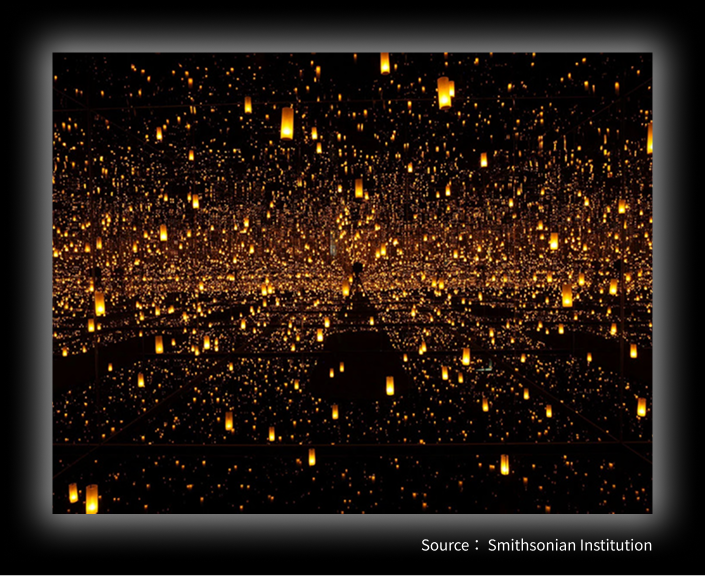
At the age of 36, also in New York, she created the first of what would become the Infinity Mirror Rooms.
Driven by obsessive impulses, she sewed hundreds of soft phallic fabric objects by hand and filled a mirrored room with them. When viewers enter the space, the reflections multiply endlessly, creating the illusion that the forms continue infinitely.
This concept, too, has continued as a series.
● Narcissus Garden
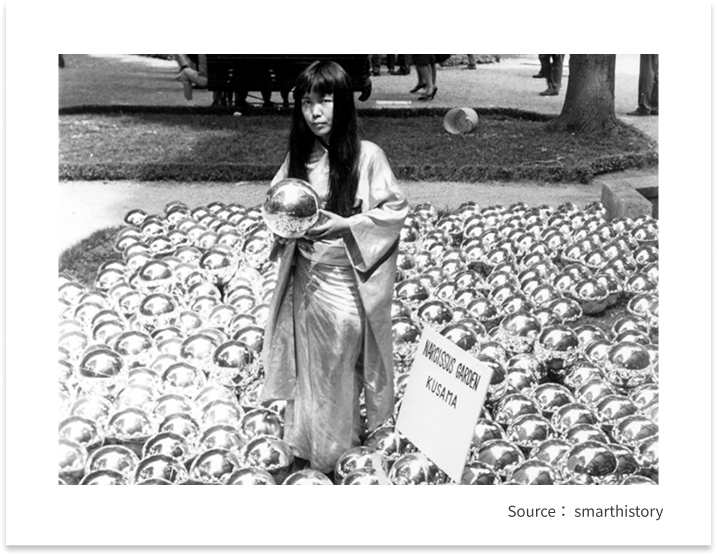
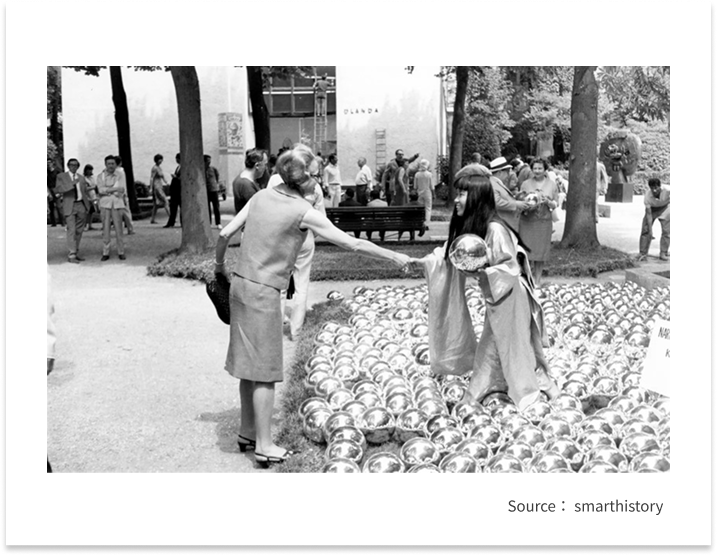
At the age of 37, Kusama brought an unconventional project to the Venice Biennale in Italy.
Without official permission, she installed the work outdoors. Hundreds of mirrored balls were spread across the lawn. Holding a sign that read “Your Narcissism for Sale,” she began selling the balls to passersby for two dollars each.
If I were to choose just one impression from these works and their stories, it would be this:
A relentless will to go on living.
A life lived with unwavering resolve in the face of adversity.
That is the feeling that quietly comes through to me.
Pumpkins
Is there a food that holds a symbolic meaning for you?
It’s a little different from simply liking the taste. It may not be something you can answer right away. But for Kusama, that food is the pumpkin.

Source:Benesse Art Site Naoshima
In her autobiography, she writes that her fascination with pumpkins began when she was an elementary school student, during a visit to her grandfather’s fields. Something about them spoke to her — their unpretentious presence, their sense of generosity, their sturdy strength.
Pumpkins appear again and again in her works, eventually becoming one of the most recognizable icons that represent her.
As for me, the food that feels symbolic is the “apple.”
For some reason, apples strongly evoke a sense of mystery, intelligence, and charm. For someone like me who loves history and science, the apple is irresistibly linked to so many things — Adam and Eve, Newton, even Apple Computer. Somehow, the apple has always felt like something quietly magnetic to me 🍎

And there’s another small delight:
when you cut an apple in half, the core forms a little star ⭐
That’s all for today’s article.
If the dazzling presence of Yayoi Kusama has brought even a small light to your heart — especially if you, like me, might be an introvert — then I would be very happy :)