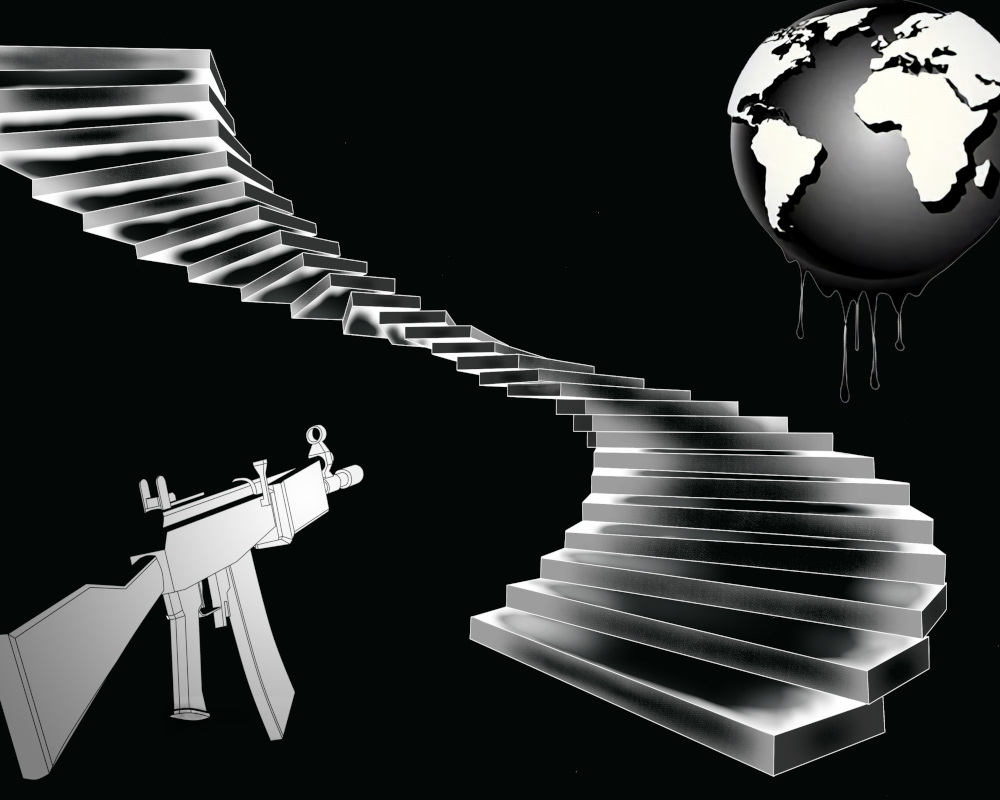
The other day, I watched an NHK (Japan’s public broadcaster) program featuring Barefoot Gen, a manga about war. It made me think deeply once again about war, and I ended up writing this article. In the end, the story takes a turn toward something like a “Planetary Defense Force?”— almost science fiction 😅 If you’re interested, please read on.
First, one thing. Whenever I think about war, my mood inevitably sinks. It’s a delicate subject, and part of me wondered if I should avoid it. But this year marks an important milestone, and I recently visited Nagasaki. And then there was Barefoot Gen. All of that made me want to write down my own reflections on war. I hope you’ll stay with me.
Why Does War Continue?
This August marks 80 years since 1945, the end of World War II. For some, it feels like “already 80 years,” for others, “only 80 years.” For me, it’s the latter. Considering the vast gap between those times and our peaceful present, it feels as if just 80 years have passed.
I sometimes imagine: what if I had been born only half a century earlier? I might have been drafted, sent to the battlefield, and perhaps died young. That feels all too real — it’s not some distant story. In fact, my grandfather was nearly drafted, but for physical reasons, he was exempt and never went to war. If he had gone, I might not be here at all. That thought leaves me with very mixed feelings. How about your family?
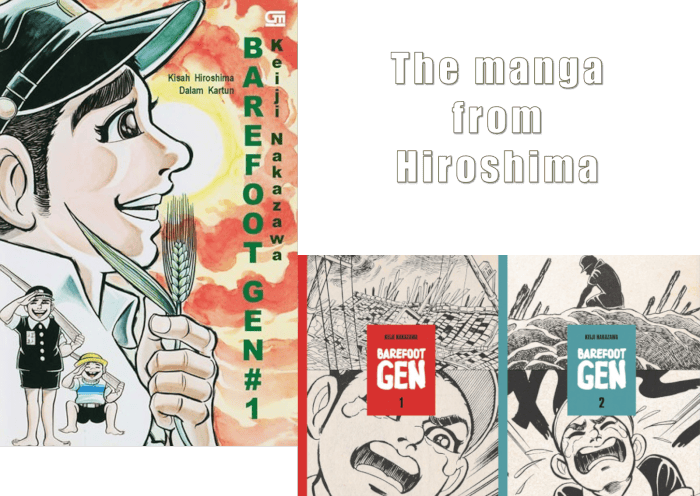
It is based on the author’s own experience as an atomic bomb survivor. It depicts Gen, the main character, struggling to survive through the chaos of wartime and postwar Japan.
Still, for someone like me living today, war feels like something of the distant past. Yet, if we look at the world, there are places where war is still ongoing. From ancient times thousands of years ago until now, human history could almost be called the history of conflict — countless blood and tears have been shed. And even today, when food, clothing, and shelter are far more abundant than in the past — when we could seemingly live without wanting for anything — these conflicts still do not end.
Why is it that war never disappears?
――― I can’t help but ask myself that question.
Aufheben
Have you ever heard the word Aufheben?
It’s a term used by the German philosopher Hegel. It means to first negate (or break down) conflicting elements, but also preserve what is valuable in them, then integrate and elevate them to a higher dimension. It looks something like this when drawn as a diagram.
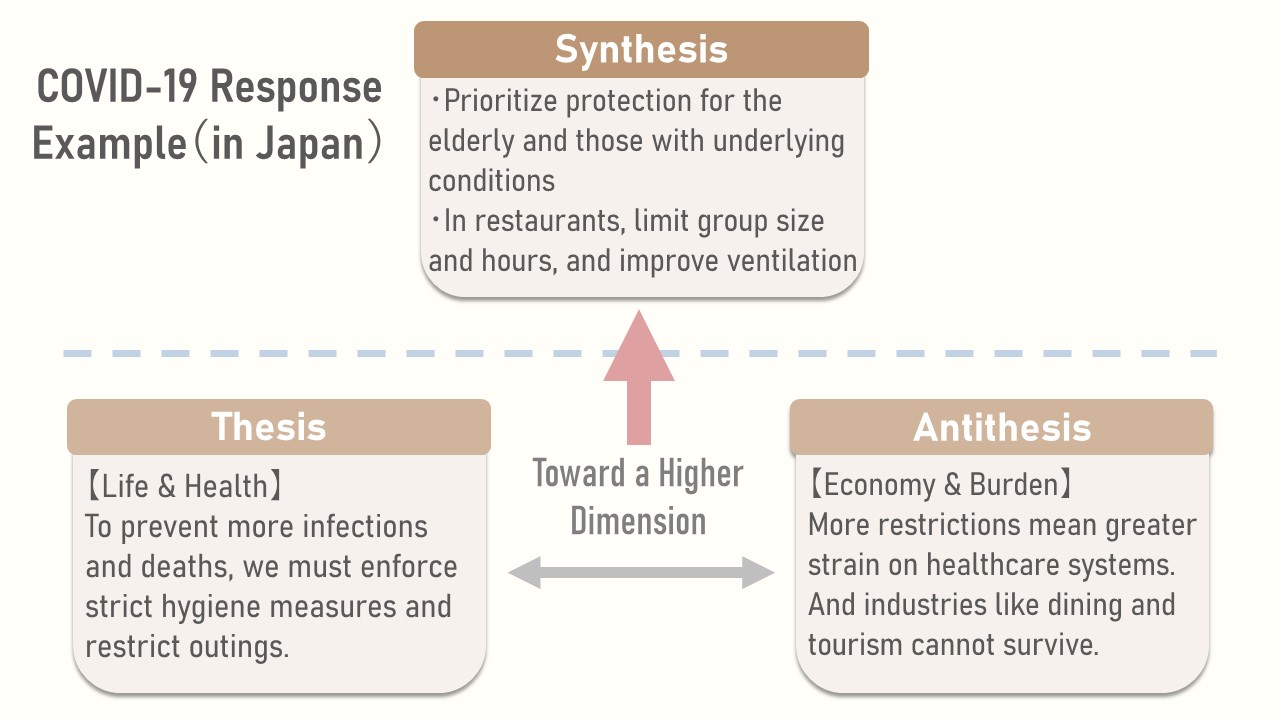
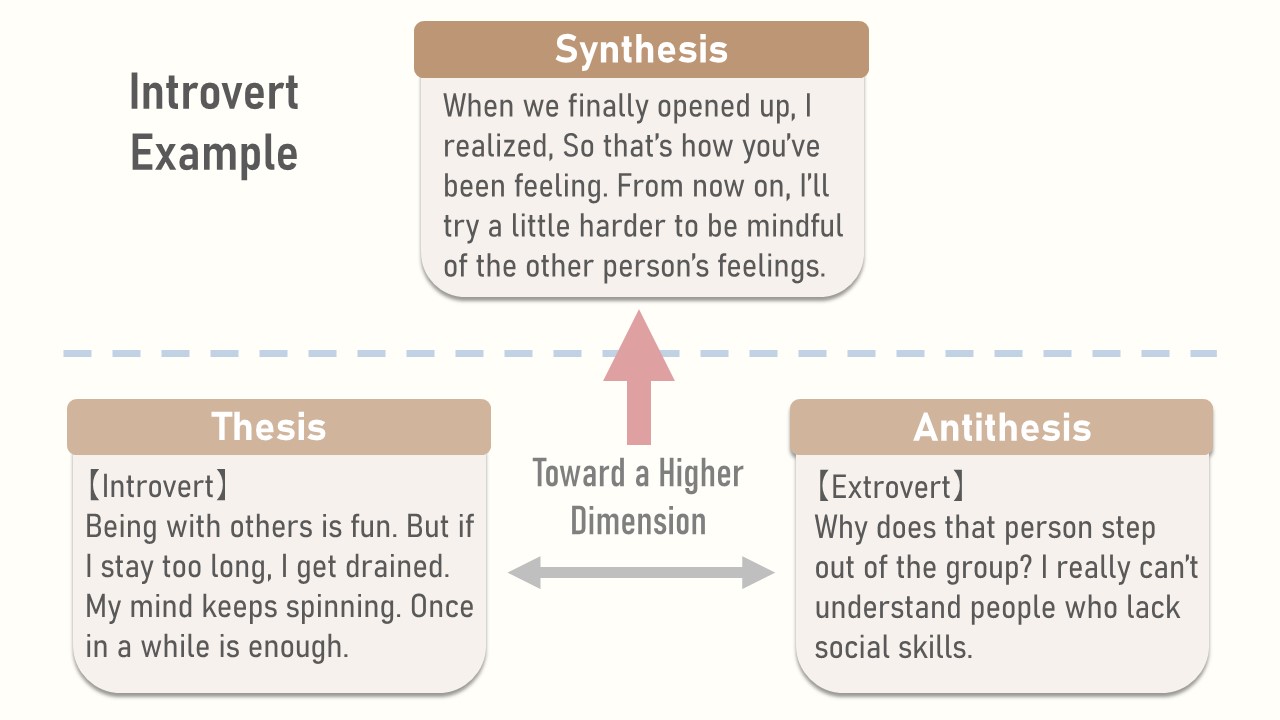
And synthesis is not the final stop — it becomes the next thesis, continuing like a spiral staircase, always seeking higher levels of development.
The reason I bring up Aufheben is because I believe war cannot be solved if we only think in terms of “my country versus your country.” In war, each side raises its own flag of justice, insisting the other is wrong, and begins fighting. But in truth, very few things are black-and-white, right-or-wrong. Still, nations rarely doubt their own righteousness.
Wars are tangled in complex causes — ethnicity, religion, territory, resources, politics, economics, history. But at the root, I think they are much like children’s quarrels. It starts small — wanting something from the other, being annoyed, being ignored or treated coldly, teasing, or pushing — and then escalates into a fight. Neither side is wholly at fault, yet once it begins, it’s hard to stop, and even harder to be the one to step back and apologize.
Humanity’s Common Enemy: Climate Change
Now, let’s change the subject. Summers over the past decade have been unbearably hot ☀️ And it feels like each year is hotter than the last 💦
Compared with when I was a child over 30 years ago, the difference is dramatic. Even last year, when I traveled to Italy, I was shocked by the heat. I had imagined the mild Mediterranean climate, but it was not so. Today, “global warming” feels too soft a phrase —“global boiling” seems closer to reality. Extreme weather is becoming the norm, ecosystems are shifting・・・
Thinking of the future, I worry more about the children than about us adults. If temperatures keep rising at this pace, what kind of world will they inherit? In Japan, cicadas singing in spring, cherry blossoms blooming strangely, summers so hot you can’t go out without something like an air-conditioned spacesuit — no one can predict exactly. Maybe it won’t be as bad as we fear, but lifestyle will surely be different.
This may sound dystopian, but here’s the point I want to make:
we don’t have the luxury of fighting each other. The real enemy is climate change. Nations should stand together as allies, pooling wisdom to face it. This is the moment for Aufheben — to move beyond the thesis of “us” and the antithesis of “them” and rise to a higher synthesis.
In fact, if we think of nations as “lower-level concepts” then a higher concept — climate change on a planetary scale — can unify them. Sports offer an example: within Japan, prefectures compete fiercely, but on the global stage, people unite as Team Japan.
Climate change is an enemy humanity itself has created. It starts with each of us reflecting on our own lives. That awareness spreads to families, communities, nations, and eventually beyond borders — uniting the world 🌏 Maybe my words here won’t change much. But there is hope: young people, like Greta Thunberg, are already moving, already raising their voices.
From my perspective as someone who has studied history, human progress has never been smooth. Generations before us worked tirelessly, stacking one effort on top of another, building the peace and prosperity we enjoy. I believe we have a responsibility not to break it, but to pass it on — like building blocks — to the next generation.