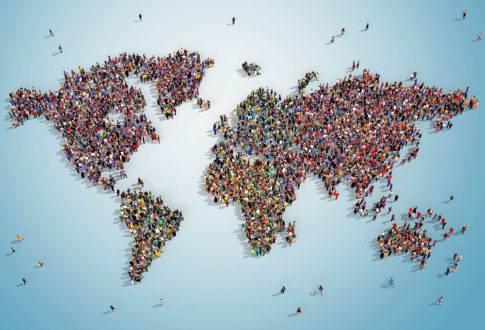

This time, let’s take a journey beyond Japan to explore how introverts are seen around the world. As I looked into it, I found it fascinating how introversion varies from country to country!
Asian Cultures Tend to Be More Introverted
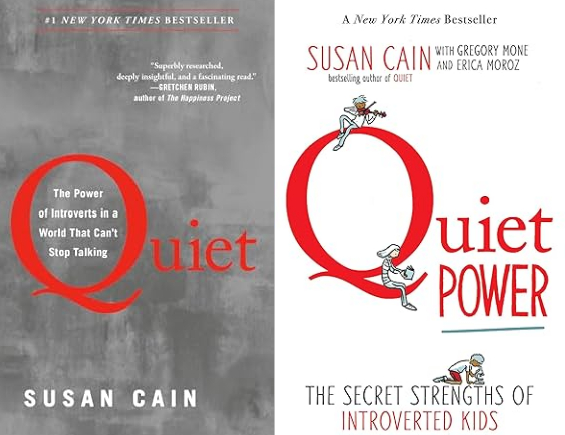
Let’s begin with insights from Susan Cain, an American author and expert on introversion. In her book, she highlights the contrast between introverts and extroverts through examples from American classrooms, focusing on cultural backgrounds.
Why don’t Asian students speak up in class?
In traditional East Asian education, the classroom is a place for quiet listening. The focus is often on reading, writing, and memorization. Speaking out is not emphasized, and students are expected to remain silent during lessons.
Also, Chinese-American high school students tend to prefer friends who are humble, altruistic, honest, and hard-working. But their American peers look for friends who are fun, energetic, and outgoing.
A Global Map of Introversion and Extroversion
Susan Cain also refers to a world map created by psychologist Robert McCrae and published in the Journal of Research in Personality. Let’s take a little trip around the world, shall we?
First, Asia. Countries shaded in red are those with a higher proportion of introverts.
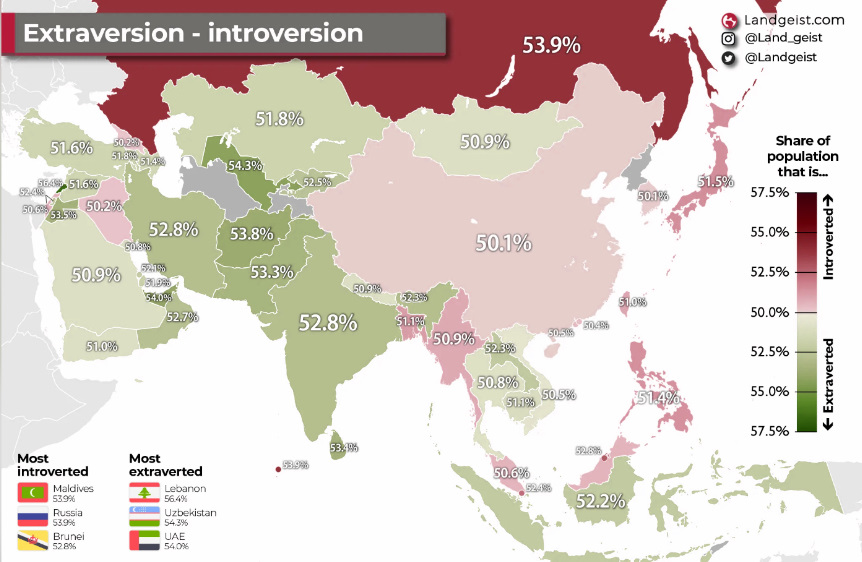
The numbers show what percentage of the population tends to lean introverted. Japan, it seems, has a slightly higher number of introverts (though of course, it varies by region…).
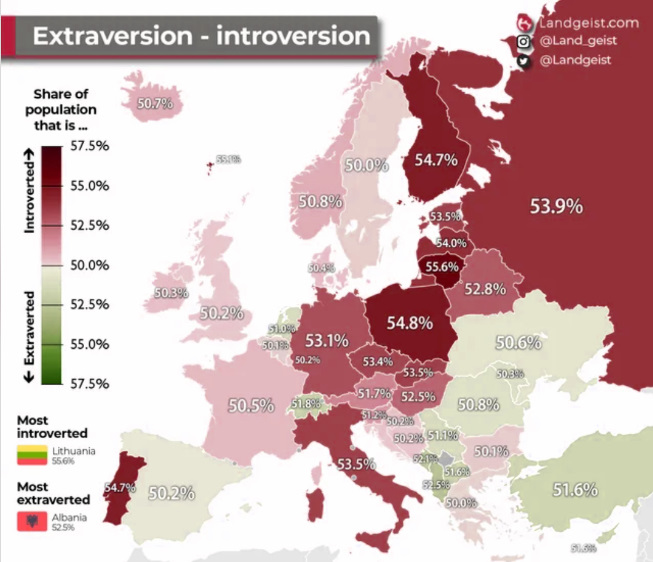
Next, Europe. Russia shows a high percentage of introverts — somehow, that feels about right.
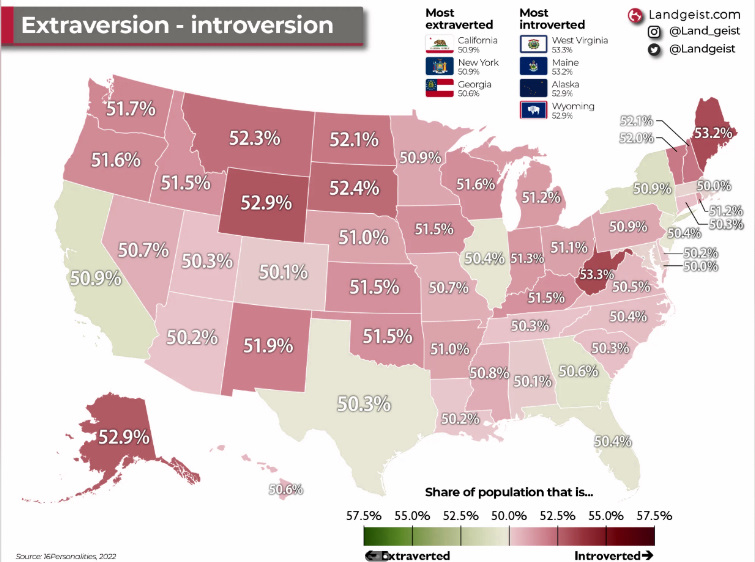
And finally, the United States. While there are differences from state to state, introverts are said to be the majority. Really…?
Susan Cain does offer a word of caution:
This map paints Asia as introverted and Europe as extroverted. But it’s a broad generalization that doesn’t account for local differences. Stereotyping entire nations or races isn’t helpful. But, it would be a shame to ignore the influence of culture on personality altogether.
The Influence of Confucius in East Asia
Why such clear differences in thinking? One answer lies in the deep respect for education in Asia, especially in the “Confucian belt” of China, Japan, and Korea.
Another reason lies in identity through the group. Asian cultures tend to be group-oriented. But the meaning of “group” here differs from the Western concept. In Asia, individuals are seen as part of a larger whole — whether it’s family, company, or society. Harmony within the group is considered extremely important. People often place the needs of the group above their own desires, and their place within the social hierarchy is key to their identity.
In contrast, Western cultures are built around the individual. People see themselves as independent units — free to speak their minds, chase their dreams, and live life on their own terms. Even if they enjoy being part of a group, they don’t necessarily conform to it. They love and respect their parents, but wouldn’t say obeying them is a child’s duty.
Interestingly, Japan has a form of social anxiety called “taijin kyofusho”, often translated as a fear of interpersonal relations. In Western cultures, people tend to be overly concerned with how they themselves are perceived. In contrast, in East Asian cultures, people are more concerned with how their behavior affects others.
How did you feel reading all of this so far?
For me, many parts really resonated.
The way we approach class, the way we think about individuals and groups, and even how we handle relationships — it all felt surprisingly accurate.
Of course, we can’t say every Japanese person is the same, but I do believe there are shared values and a kind of national character that runs underneath it all (Most people would agree that each prefecture even has its own personality)
And when it comes to the influence of Confucianism — I’ll admit, I used to think of it as something from the distant past, something we just read about in textbooks, with little to do with who we are today. But clearly, it still shapes us in subtle, unconscious ways. We don’t usually notice it, but it’s there.
In terms of religion, Japan also has Shinto, Buddhism, Christianity, and more — and I’m sure those beliefs leave quiet traces in us too (That’s a topic I’d love to explore another time)
Finland — Another Nation of Quiet Souls
Now let’s shift our focus — this time to Finland, in Northern Europe.
What comes to mind when you think of Finland?
For many in Japan, it might feel like a faraway place — so far, in fact, that some people might not even be sure where it is. Some may know it’s a Nordic country, but beyond that, it can be hard to picture.
I don’t know that much about it either, but here’s what I do know:
Finland is a country rich in nature, with a strong social welfare system. And of course — it’s the birthplace of Santa Claus. More recently, it’s also become known in Japan as the original home of the sauna ♨️

As we saw earlier on that global map, Finland is said to have a relatively high proportion of introverts. Knowing that makes it feel a little closer, doesn’t it?
There’s a book that gives a glimpse into what daily life looks like for introverts in Finland. I found it deeply relatable — and I imagine many Japanese readers would too, especially since introversion is considered fairly common in Japan (In my case, very common 😅)
So, what did you think of this little tour around the world?
Some parts may feel spot on, others not so much.
But when you look beyond your own borders, there’s a whole world of perspectives waiting to be discovered. Pretty fascinating, isn’t it?