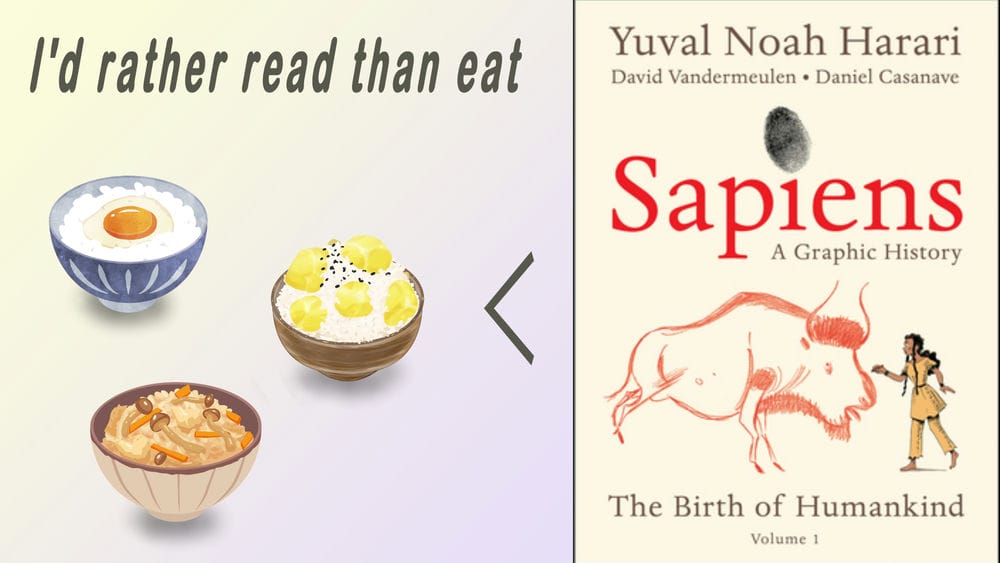
Today I want to share a book I truly recommend 📖
If history has ever felt dull to you — or if school lessons even made you dislike it — this might be the book that changes your mind.
What Kind of Book Is This?
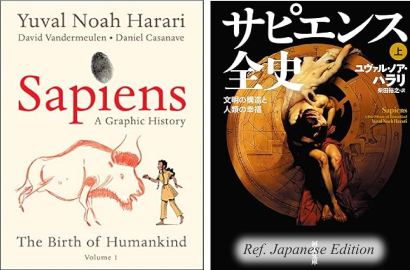
Written by an Israeli historian, Sapiens is a dramatic and sweeping account of human evolution and history. At nearly a thousand pages, it’s a massive read — yet once you start, the length simply disappears. Page after page pulls you in, and you may even marvel at how the author managed to fit millions of years of human history into a single volume.
The book explores humanity’s past, present, and future through three major revolutions: the Cognitive Revolution,
the Agricultural Revolution,
and the Scientific Revolution.
Why was it that Homo sapiens — Latin for “wise man” — who once lived so precariously in Africa, managed to surpass other human species like the Neanderthals and rise to the very top of the food chain?
According to the author, the key was our unique ability to believe in shared fictions — myths, religions, laws, money, and more. And while the shift from hunter-gatherer societies to agricultural ones brought stability and productivity, it also led to longer working hours, nutritional imbalances, and greater social inequality — a shift the author even calls “the biggest fraud in history.
This is a book that can completely change the way you see history.
The Dynamism of History

What I felt most strongly while reading was that this book doesn’t present history in the usual dry, textbook fashion — a flat list of “this happened in year X.”
Instead, it unfolds events as a continuous story: what happened, the background behind it, and how it eventually led to what came after. With the author’s sharp insights woven in, it felt completely different from the image of history I had from school. I truly felt the dynamism of history — and at times, as I read, it stirred something deep inside me 🔥
This approach might seem normal in places like the U.S., but in East Asia, including Japan, history education tends to focus on memorization rather than understanding historical contexts and consequences. In Japanese schools, for example, history exams often ask questions like “In what year did this event occur?”, which forces students to memorize timelines rather than analyze their significance. To be honest, I always found that a bit frustrating 😅
That’s why Sapiens was such an eye-opening read for me. It was one of the books that made me realize history isn’t just about remembering dates — it’s about understanding the flow of human civilization.
Our Lives Will Become Part of History Too
History isn’t only about great events in textbooks or the evening news. It’s also hidden in the everyday things around us:
・the fact that we exist here and now
・the computer screen in front of us
・even the language we use
・・・
Everything has its own history, its reasons, its background. And within that history are countless dramas — joys and sorrows, triumphs and struggles — not only of great figures, but of ordinary people as well.
Not long ago, a Japanese politician, Sanae Takaichi, said something that really stayed with me:
The present we live in is the future our ancestors risked their lives to protect.
(I’m not sharing this as a political statement — I just resonated with the words themselves)
So, if you’ve ever disliked history because it felt like nothing but rote memorization, give this book a try. I can’t promise it will make you fall in love with history — after all, everyone connects with it differently — but one thing’s certain:
Sapiens will give you a new perspective, and maybe even a sense of excitement you never expected❗