

In my previous post, I talked about the joys of reading (article here).
This time, I’d like to introduce one of my personal favorites 📖
A Book Filled with the Author’s Heart
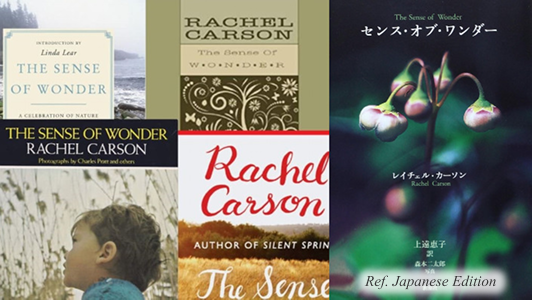
It’s a book that carries the hope that we never lose “the sense of wonder” — the ability to be moved by the beauty and mystery of nature, and the curiosity to ask,
“Why?” and “How?”.
Written by a pioneering female biologist and environmental activist, it was dedicated to her beloved grandnephew, Roger, whom she cherished like her own child. This global bestseller embodies her wish for him — and for all of us — to hold on to that childlike sense of awe.
In it, the author looks back on her days with Roger — days filled with seeing, hearing, smelling, touching, and feeling the beauty and tenderness of life and nature. Those moments are captured in lyrical, poetic prose and evocative photographs.
Even while battling cancer, she continued to write, but sadly passed away before finishing the manuscript. Thanks to her friends, who carried on her wishes, the book was published after her death.
Reminiscence
Whenever I read this book, I’m brought back to a summer’s end from my own childhood😌
It was near the close of summer break. I was still in elementary school, heading into the nearby mountains with my friends to hunt insects. The cicadas were so loud they filled the air, and we chased our quarry with all our might. As the sun set, we made our way home along the narrow paths between the rice paddies, insect cages in hand.
It’s the kind of memory many Japanese men can instantly picture — a quintessential scene of boyhood.

Although the book is set in America and written in a different era from my own childhood, it stirs emotions that transcend time and place: childlike innocence~longing~nostalgia — feelings I believe are shared by all humanity.
As the years pass and children grow into adults, work and family fill our days. Those once-vivid feelings are pushed aside and eventually forgotten, like a fleeting dream. But this book has the power to bring them back — to take us by the hand and lead us to the child we once were, brimming with wonder and excitement.
The Mystery of “Wonder”
The Japanese word fushigi (不思議, “wonder”) is said to come from the Buddhist term fukashigi (不可思議). Shigi (思議) means “thinking” or “reasoning,” and fukashigi literally means “beyond thinking” — something the mind cannot fully grasp.
In ancient Buddhist texts, the word was often used to praise the inexpressible power of the Buddha. Over time, it came to refer more broadly to things that defy ordinary understanding.
If I were to loosely interpret the book’s title, The Sense of Wonder, it would be “the ability to find wonder in the ordinary.”
At its core lies an endless curiosity — a desire to explore and understand the countless mysteries of the world. For children, who have yet to accumulate a sense of “the ordinary,” everything they encounter is vivid and fresh, and their curiosity knows no bounds.
Scholars and researchers — many of whom are said to lean toward introversion — are often described as having a particularly strong curiosity. Looking back, I realize that curiosity has been one of the key forces driving me forward all my life. The serious reading habit I’ve cultivated over the past decade has been a perfect answer to that inner drive. (Secretly, I even dream of being a scholar in my next life) 😅
That said, for most people, curiosity tends to fade as they grow from child to adult. This book has the power to revive it — to bring back, in vivid detail, the sense of wonder we once knew. It’s truly a book worth experiencing💫